How Much Does a Kitchen Renovation Cost in NYC in 2026?
If you have searched for kitchen renovation costs in NYC and walked away more confused than when you started, you are not alone. The numbers you find online range from $30,000 to well over $200,000, with very little explanation of what actually drives the difference.
The honest answer is that a kitchen renovation in New York City is not a fixed-price product. The cost depends on the size of the space, the condition of the building, the scope of the work, and the quality of materials and finishes you choose. What this guide will do is give you a clear picture of what realistic budgets look like at different levels, what pushes costs in either direction, and how to think about where your money is best spent.
We have completed kitchen renovations across Brooklyn and Manhattan at a wide range of budgets. The numbers and guidance below reflect that real-world experience. If you want to talk through what a renovation might look like for your specific kitchen, we are always happy to have that conversation.
Why Kitchen Renovation Costs Are Higher in NYC
Before getting into numbers, it helps to understand what makes NYC kitchen renovations more expensive than national averages. This is not about overpriced contractors. It reflects real conditions on the ground.
- Labor costs: Skilled trades in NYC command significantly higher rates than most other markets. Licensed plumbers and electricians working in residential buildings operate under specific requirements that reflect both the cost of living and the complexity of the work.
- Building logistics: Working in a co-op, condo, or brownstone adds layers that do not exist in a standalone home. Deliveries, material hoisting, elevator usage, restricted working hours, and building-specific requirements all affect how a project runs and what it costs.
- Material access and expectations: NYC homeowners generally have access to and preference for higher-end finishes. The range of what is available is wide, and material choices have one of the largest impacts on where a project lands in the cost range.
- Permit requirements: Depending on scope, permits may be required. Any work touching plumbing or electrical will likely trigger a filing. This adds cost and time, and it is the right way to do the work.
DCON Note
These are factors we navigate on every project. Understanding them upfront helps set expectations that hold throughout the process, which makes for a smoother renovation for everyone.
Kitchen Renovation Cost Ranges in NYC
These ranges are based on real project experience in Brooklyn and Manhattan. Every kitchen is different, and the variables below are what move the number within and beyond these ranges.
Renovation Level | Typical Cost Range |
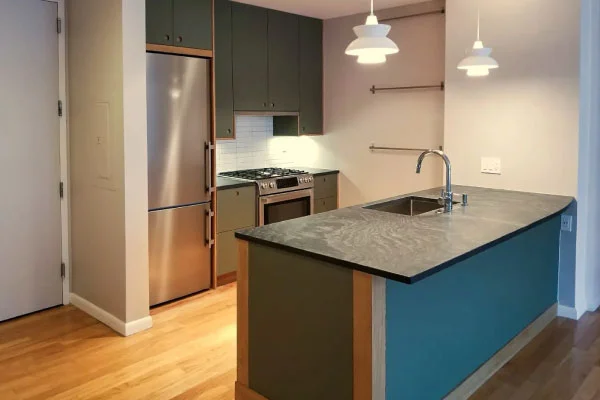
Refresh: cosmetic updates within the existing layout. New cabinetry, countertops, appliances, and finishes, no structural changes or plumbing and electrical relocation | $45,000 to $65,000+ |
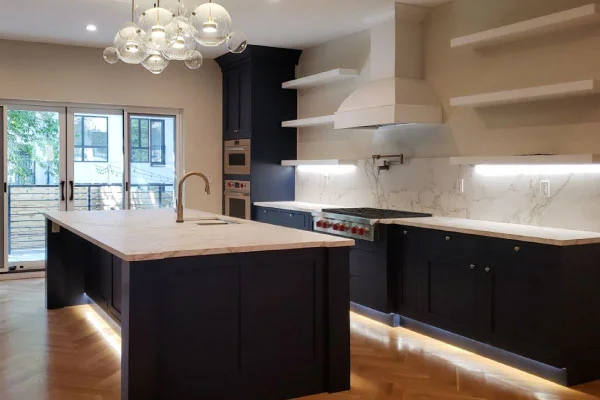
Mid-range: full gut or cabinet reconfiguration with semi-custom or custom cabinetry, new appliances, and updated finishes throughout. Investment focused on quality and function | $60,000 to $120,000+ |
High-end: full gut with a higher level of customization throughout. Fully custom cabinetry and millwork, premium stone, high-specification or integrated appliances, every detail considered | $130,000 and up |
A refresh covers new cabinetry, countertops, appliances, and finishes while keeping the existing layout and plumbing in place. No structural changes, no relocation of services. It is the most cost-effective path when the bones of the kitchen work and the goal is a meaningful visual and functional upgrade.
A mid-range renovation can be a full gut or a cabinet reconfiguration. The scope varies, but the focus is on quality and function throughout: semi-custom or custom cabinetry, new appliances, and updated finishes. The layout may or may not change. This is where most of our clients land.
A high-end renovation is also a full gut, but the distinction from mid-range is the level of customization and finish quality. Fully custom cabinetry and millwork, premium stone surfaces, high-specification or integrated appliances, and a design-forward approach where every detail is intentional. The investment reflects both the materials and the complexity of execution.
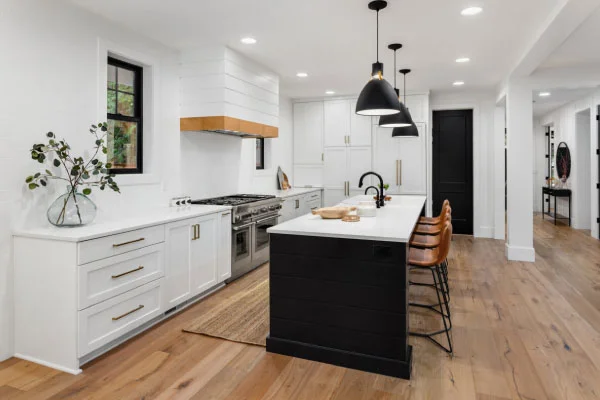
The range is wide because the variables are wide. What matters most is understanding which variables apply to your project and making decisions that reflect your priorities.
What pushes costs higher
- Structural changes such as removing walls or relocating plumbing and electrical
- Fully custom cabinetry and millwork
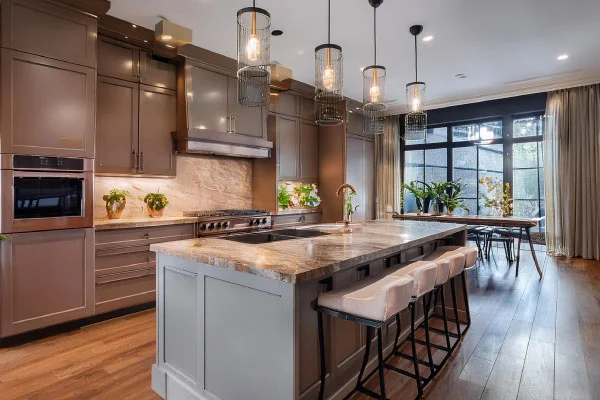
- Premium stone countertops and specialty tile
- High-specification or integrated appliances
- Building-specific requirements in co-ops or condos
- Older buildings with outdated systems that need upgrading before finish work can begin
What keeps costs more manageable
- Keeping the existing layout, which avoids plumbing and electrical relocation
- Semi-custom cabinetry in place of fully custom
- Thoughtful material selection, prioritizing investment where it is most visible
- Clear scope and decisions made early, which reduces changes once the project is underway
DCON Note
Our design-build process helps clients understand early where their budget will have the most impact. Material and scope decisions are made in the context of the full project, not in isolation.
Where Your Budget Actually Goes
A kitchen renovation budget is made up of several distinct categories. Understanding the typical allocation helps when deciding where to invest and where to be more flexible.
Category | Approximate Share of Budget |
Cabinetry and hardware | 25 to 35% |
Labor (installation, licensed trades) | 35 to 45% |
Appliances | 10 to 20% |
Countertops | 8 to 12% |
Flooring and tile | 5 to 10% |
Plumbing and electrical | 5 to 10% |
Fixtures, lighting, and finishing details | 5 to 8% |
These are approximate ranges and will vary by project. They are intended to give a directional sense of where the budget goes, not a precise formula.
Cabinetry is consistently one of the largest material cost drivers in a kitchen renovation, which is why it is one of the first decisions that shapes the overall budget. Custom cabinetry offers the greatest flexibility for unusual layouts and premium finishes but comes at a meaningful premium over semi-custom options. Semi-custom cabinetry has improved significantly and delivers excellent results at a more accessible price point.
Labor is often underestimated by homeowners who focus primarily on materials. In NYC, skilled trade labor is a meaningful part of the total investment. Cutting corners here tends to create problems that cost more to fix than the savings on the front end.
Where to Invest and Where to Be Flexible
Not every line item in a kitchen renovation deserves the same level of investment. Part of what DCON’s design-build approach offers is guidance on these decisions before they are locked in, so budget choices inform design rather than constrain it at the last minute.
Worth investing in
- Cabinetry and hardware: You interact with these every day. Quality construction and thoughtful hardware make a real difference in how the kitchen feels to use and how long it holds up.
- Countertops: A quality stone countertop elevates the entire space and holds up well over time. This is the most visible surface in the kitchen and worth treating accordingly.
- Appliances: If cooking matters to you, this is where to invest. Integrated appliances that disappear into the cabinetry are a worthwhile upgrade in a design-forward kitchen.
Where to be more flexible
- Backsplash tile: There are beautiful options across a wide price range. Restraint here can work beautifully and free up budget elsewhere.
- Lighting fixtures: Thoughtful placement and the right fixture type matter more than price. Good lighting design is about how the space is lit, not how much the fixture costs.
- Flooring: If the rest of the apartment has consistent flooring, extending it into the kitchen is often a cleaner and more cost-effective choice than introducing something new.
The Hidden Costs to Plan For
Most kitchen renovation budgets should include a contingency for costs that emerge once the project is underway. This is especially relevant in older NYC buildings, where conditions behind walls are not always known until demolition begins.
Common costs to anticipate beyond the base renovation scope:
- Outdated electrical panels or wiring that need upgrading to support modern appliances
- Plumbing that does not meet current code requirements
- Subfloor issues that need addressing before new flooring can be installed
- Asbestos or lead paint remediation in older buildings
- Unforeseen structural conditions behind walls
A contingency of 10 to 15 percent of the total project budget is a reasonable buffer for most renovations. Projects in older buildings or those involving more significant scope should lean toward the higher end of that range.
DCON Note
We flag known risk areas during pre-construction so clients are not caught off guard. While no one can predict everything, experience with NYC buildings means we know what to look for and how to address it when it comes up.
How to Get an Accurate Number for Your Kitchen
An accurate number for your specific kitchen requires an in-person conversation and a look at the space. The variables that affect cost, from your building’s requirements to your layout goals to your material preferences, are too project-specific for any general estimate to be meaningful without that context.
A few things that help before that first conversation:
- Be clear on what the kitchen needs to do differently. Function first, then aesthetics.
- Think about whether you want to work within the existing footprint or reconfigure. That single decision has one of the largest impacts on cost. You can explore examples of how we have approached this in past projects for reference.
- Have an honest budget conversation early. A good design-build firm will tell you whether your goals and your budget are aligned before design begins, not after.
DCON Note
Our initial consultations are a conversation, not a sales pitch. We want to understand your project and give you a realistic picture of what it will take before you commit to anything.
The Bottom Line
Kitchen renovations in NYC are a real investment. The range is wide because the variables are wide. But with the right team, the decisions that shape your budget become clearer and more intentional.
Whether you are at the very beginning of your thinking or already have a clear vision, we would be glad to talk through what your project might involve. Take a look at our completed kitchen projects for a sense of what we do, and reach out whenever you are ready.
🔗 Explore More
Learn more about what DCON can do for your home:
Recent Articles
Categories
- Apartment Renovation (32)
- Basement Renovation (7)
- Bathroom Remodeling (28)
- Brownstone Renovation (16)
- Design | Build (19)
- Eco-friendly Renovation (4)
- Exterior Renovations (4)
- Home Remodeling (20)
- Home Renovation (27)
- Interior Renovation (31)
- Kitchen Remodeling (26)
- Other (4)
Related Articles